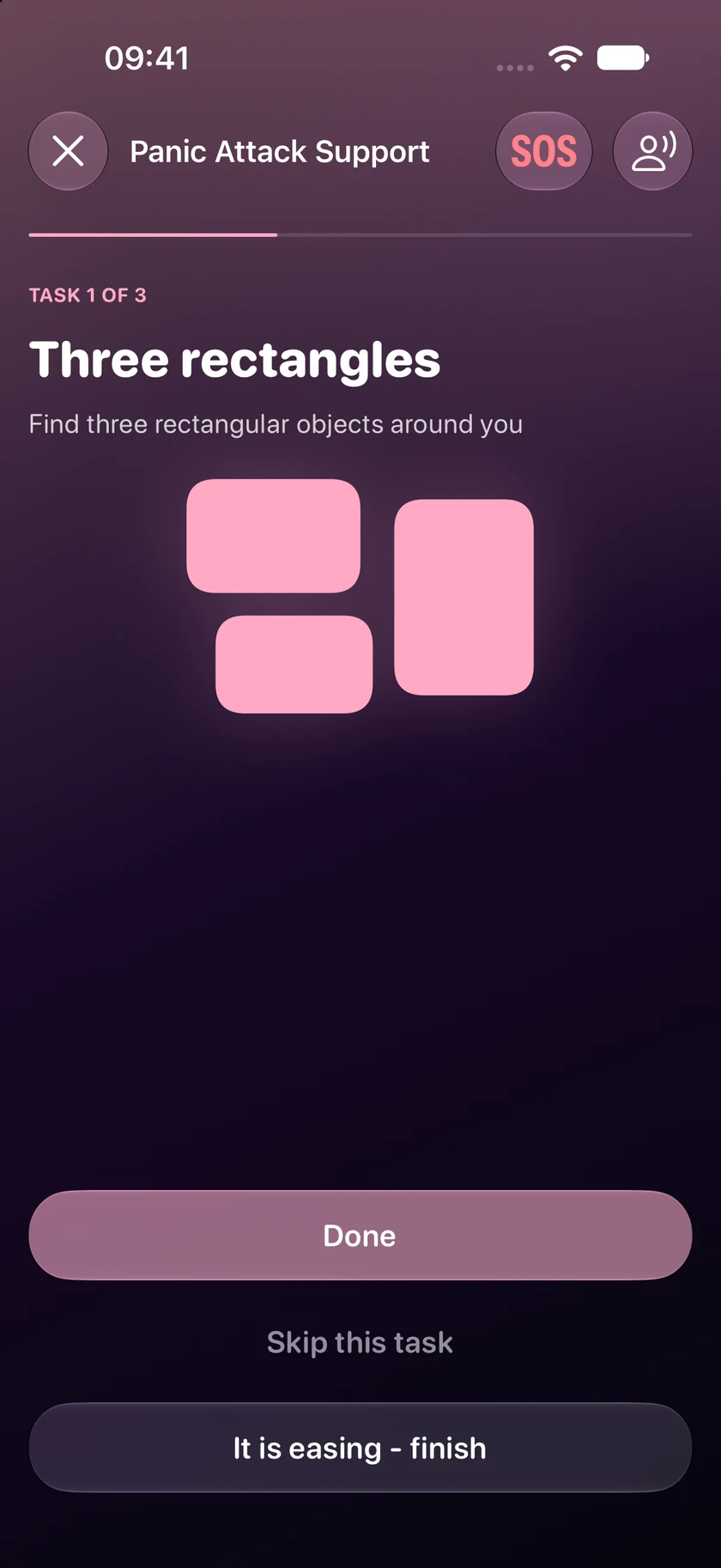
What grounding is
Grounding means gently moving your attention away from anxious thoughts and towards what is happening around you right now. Instead of arguing with a worry, you give your mind something concrete and neutral to notice.
Many people use grounding when they feel anxious or overwhelmed, or during a panic attack. You do not need any equipment, and nobody around you needs to know you are doing it.
How to do the 5-4-3-2-1 technique
Start with one slow breath out. Then move through your senses, one at a time. Take your time with each step.
- 5 things you can see. Look around and name five things. Notice details: a colour, a shape, the way light falls on a surface.
- 4 things you can feel. The chair under you, your feet on the floor, the fabric of your sleeve, the temperature of the air on your skin.
- 3 things you can hear. Traffic outside, the hum of a fridge, your own breathing. Listen for quiet sounds as well as loud ones.
- 2 things you can smell. Coffee, soap, fresh air. If you cannot smell anything, name two smells you like.
- 1 thing you can taste. Notice the taste in your mouth, or take a sip of water and pay attention to it.
Finish with another slow breath out. If you still feel on edge, it is fine to go through the steps again.
Tips that make it easier
- Go slowly. The point is not to finish quickly, but to give each thing your full attention.
- Describe, do not judge. "A blue mug with a chip on the handle" works better than "a mug".
- There are no wrong answers. If you cannot find something for one sense, skip it or add another thing you can see.
- Say it out loud if you can. Hearing your own voice can help you stay with the exercise.
- Practise when you are calm. A technique you already know is much easier to use when anxiety is high.
Other ways to ground yourself
If counting through your senses does not suit you, try one of these:
- Press your feet into the floor and notice the contact for a few breaths.
- Hold something with a strong texture or temperature, such as a cool glass of water.
- Pick a category and name examples, such as everything blue in the room.
- Breathe slowly with a longer out-breath. See breathing exercises for anxiety.
When grounding is not enough
Grounding is a helpful tool, but it is not a treatment for an anxiety disorder. If anxiety or panic attacks keep affecting your daily life, talk to a doctor or a mental health professional. Read what to do during a panic attack.
Learn more about anxiety from the National Institute of Mental Health.