Before you start
- Sit or lie down somewhere comfortable, with your shoulders relaxed.
- Breathe through your nose if that feels comfortable. If not, breathing through your mouth is fine.
- Breathe gently. You do not need to fill your lungs completely.
- If you feel dizzy or uncomfortable, stop and breathe normally for a while.
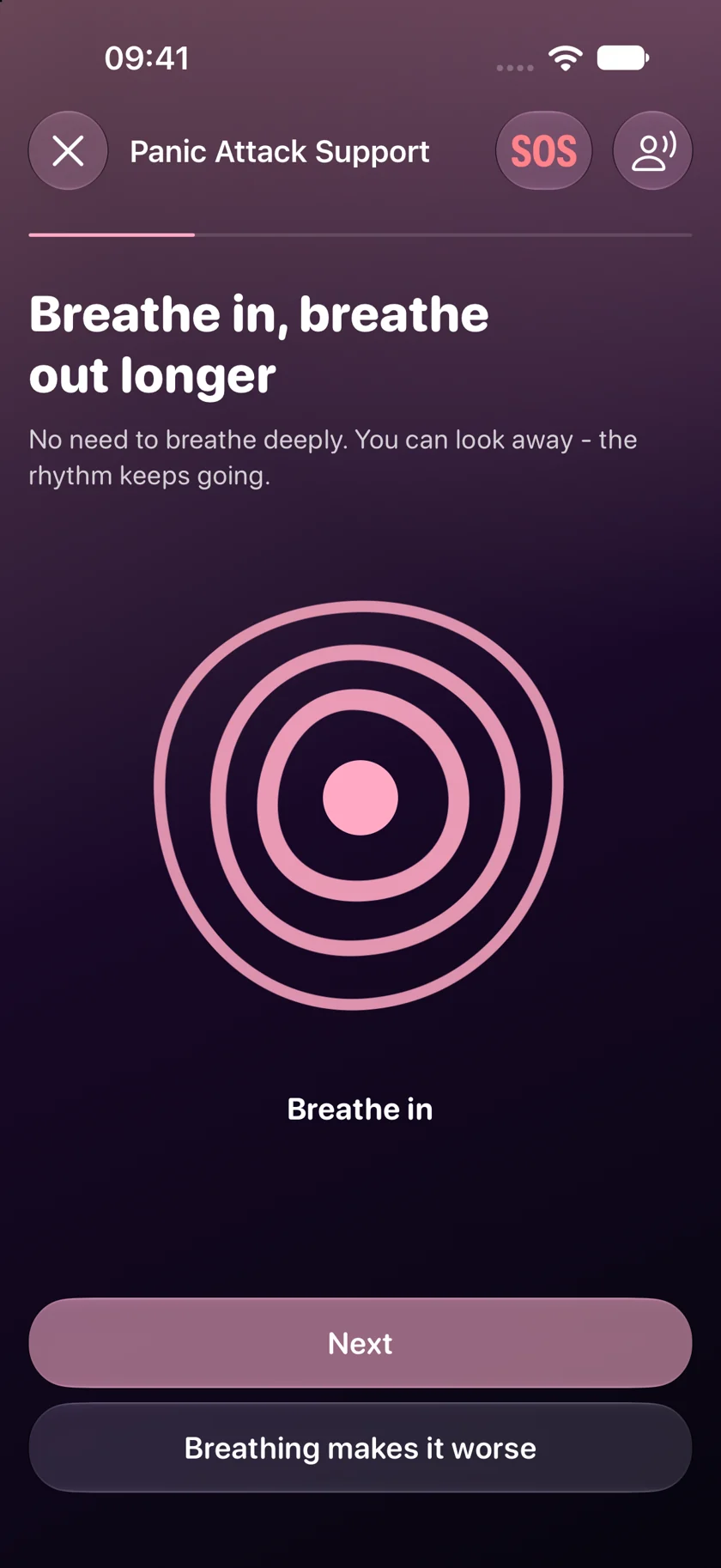
1. Slow breathing with a longer out-breath
This is a good place to start, and it is easy to use almost anywhere.
- Breathe in gently through your nose for a count of 4.
- Breathe out slowly for a count of 5 or 6, as if you were blowing through a straw.
- Keep going for 3 to 5 minutes. If the counts feel too long, shorten them; what matters is a calm, steady rhythm.
2. Box breathing
Box breathing gives your attention a simple pattern to follow. Picture tracing the four sides of a square.
- Breathe in for a count of 4.
- Hold gently for a count of 4.
- Breathe out for a count of 4.
- Hold gently for a count of 4, then start again.
If holding your breath feels uncomfortable, make the pauses shorter or leave them out. During a panic attack, the first exercise is usually simpler.
3. Belly breathing
Also called diaphragmatic breathing, this helps you notice where your breath goes.
- Place one hand on your chest and the other on your belly.
- Breathe in slowly so that the hand on your belly rises more than the hand on your chest.
- Breathe out slowly and feel your belly fall.
- Continue for a few minutes at a comfortable pace.
Using breathing during a panic attack
Keep it simple: focus on breathing out slowly rather than on taking big breaths in. Gulping air can make you feel more lightheaded.
For some people, paying attention to the breath makes anxiety stronger. That is okay. Switch to grounding with your senses instead, and see what to do during a panic attack.
Make it a habit
Breathing exercises are easiest to use under stress when you have practised them at calm times. Try a few minutes every day, for example after waking up, during a break or before bed. Linking practice to something you already do makes it easier to remember.
When to get help
If anxiety is frequent, intense or gets in the way of daily life, talk to a doctor or a mental health professional. Breathing exercises can support you, but they are not a treatment on their own.
The NHS has a short breathing exercise for stress, and the National Institute of Mental Health explains anxiety disorders and treatment.